

About Swamiji, 1863-1902.
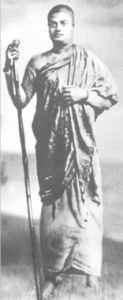
Swamiji as a mendicant.
His childhood in Kolkata, British India, was affluent. His father was a lawyer at the courts. Apart from good English (Bengali was his mother tongue) his father spoke Farsi and enjoyed Persian poetry. Swamiji’s mother was a strong influence on him and when she visited the monastery later, she would call out for him and he came running like a small boy! He got his regal bearing from her.
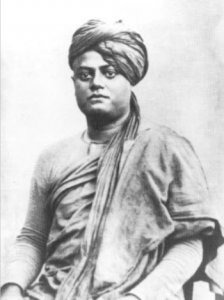
Swamiji as a mendicant
Educated by Scottish Calvinist missionaries for a BA degree, which he said he could throw in the Ganges! But he was indelibly marked.
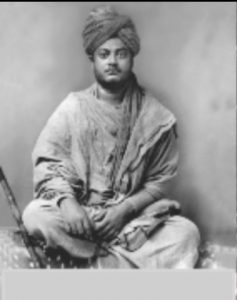
Swamiji as a mendicant
Swamiji is unique – an Eastern monk with a Western degree.
The influence of William Hastie, his Scottish, Calvanist college rector, is seen frequently –
A significant part of Swamiji’s education was the 3 years he spent at the Scottish Church College, Kolkata – this comes through in his lectures where he uses western logic. This college was run by Scottish Calvinist missionaries. The rector, the exceptional William Hastie, was ordained as a church minister. Hastie was fluent in German (self-taught at 17), Dutch, French, Hebrew (for the Old Testament), Latin and ancient Greek (having picked up from his headmaster, ‘It was always better in the original language’). Hastie was the son of a miner, from a lead mining village, Wanlockhead, which had the second subscription library in Europe (32 member miner’s library from 1750s. Gets dedicated building 1850s, no windows.). Miners paying to read – nb- this is Calvinist Scotland – in 1616 the law is passed that all parishes had to educate all boys and girls up to 12 – if parish funds were short, the state comes in – 254 years later England passes law for general education (the Scots man-in-the-street always more literate than the Englishman). The first such library was a nearby mining village 7 km away. (Benjamin Franklin starts the first lending library in Philadelphia in 1731. He was a printer and a publisher and knew how reading people needed books but couldn’t afford them).
The reason for German and Dutch was to discuss Protestant philosophy with the university philosophy professors (the Catholic countries offered nothing). Some of the German professors were (or knew) the disciples of Kant and Schopenhauer. Here were the roots of the breakthroughs in European thinking, for Hastie. It is significant that these professors were in Protestant cultures – they were ‘free-thinking’ (starting with David Hume – 1711-1776. Scotland. He was influenced by Eastern thinking from Jesuit missionaries who knew deeply the main Eastern cultures. Hume picked their brains while living at La Fleche, France, 1735-1737). Hastie was the first to translate Immanuel Kant’s work into English. Hastie was deeply influenced by Kant and his teaching carried Kant’s rationalism. It is from Hastie that Swamiji uses Kant’s famous phrase ‘Das Ding an sich’ in a US lecture, that he reads and is able to comment on Schopenhauer, J.S. Mill, William Jones, other reformers and he copies Hastie’s lecture titles. The rational approach is often mentioned in Swamiji’s lectures. [Kant’s meaning; ‘It’s not the thing as such, it’s how you see it’ – how we project. A basic in Vedanta’s message too – William Jones: ‘When we perceive we use adjustable terms’.]
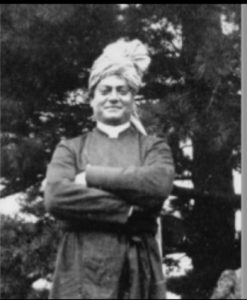
Swamiji in front of of his meditation pine tree. At the Greenacre conference at Eliot, Maine, USA. Summer, 1894. (See Book 5).
Ramakrishna’s influence starts –
At Hastie’s recommendation Swamiji met the Hindu ascetic, Ramakrishna, while studying at the Scottish College. Hastie, deeply sensitive, had visited the holy ascetic and had felt the profound spirituality (imagine a Christian minister visiting a Hindu holy-man today). In the poem The Excursion/The Ruined Cottage (Wordsworth), the line ‘… a momentary trance overcomes me …’ caused Hastie to comment, ‘If you want to see this deep trance you should visit the ascetic Ramakrishna where you can see it. It is only from supreme holiness such is achieved‘.
Ramakrishna lived in a temple garden complex (Dakshineswar) outside Kolkata. He lived an austere life and worshipped the main Goddess of the temple, Kali. He worshipped idols and practised some Hindu ceremony, but did not follow the rules. Ramakrishna’s austere living and his rejection of wordly values sunk in to Swamiji. To Swamiji’s question, ‘Have you seen God?’ came the reply, ‘Yes, more clearly than I see you now, right here!’. Ramakrishna had meditated on Christ and said he had seen Jesus. He had meditated on Mohammed and said he had seen Mohammed. Ramakrishna taught, ‘As the rivers have their different paths to the same ocean, so man has many paths to the same God’.
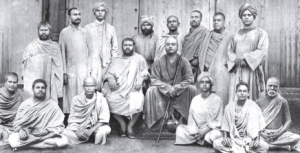
Swamiji (sitting centre with staff) with fellow monks, 1897. The monastery was to be founded in 1898. Nearly all are direct disciples of Ramakrishna, some bringing Vedanta to the West at Swamiji’s command, to continue his work.
Life is learning how to cross the ocean of delusion –
Ramakrishna said most people thought only about sex and their wealth (or lack of it). They had little spirituality. He said, to live correctly, with stability and understanding death, one did not need wordly comforts, one should not continually satisfy the senses. Living without comforts (which distract) was the only way to understand oneself. This was the only way you would find your true values and would see that the direction of your life has meaning. Then you made progress. Succeeding in life is, ‘Learning how to cross the ocean of delusion!’
Ramakrishna had charisma and his humour was enjoyed by his followers. There was a group of young men who had become attached to him. On Ramakrishna’s death, this group rejected going back to live with their parents and formed the first collection of monks, taking the Hindu vows of celibacy, poverty and vowed to unite together with the purpose of spreading Ramakrishna’s message. Ramakrishna had said Swamiji was to be their leader. They had nowhere to live though until a lay follower of Ramakrishna hired a dilapidated house for them – the first primitive monastery.
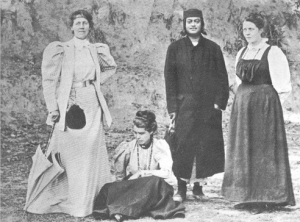 Kashmir 1896. L-R. Josephine Macleod and Sara Bull (sitting), his American supporters. Margot Noble, his Irish disciple (they met in London) who became a nun (Sister Nivedita) and started a girls’ school in Kolkata.
Swamiji’s attends the Parliament of Religions at Chicago’s World’s Fair, 1893 –
Swamiji walked the entire length of India as a mendicant taking some two years – staying with rural peasants, townsfolk, and occasionally in a palace. From this he met those who would support him and they encouraged him to travel to the Parliament of Religions in Chicago in 1893. This congress was part of the Chicago World’s Fair. Swamiji became a popular speaker at this congress – the scheduler keeping Swamiji’s speech till last to prevent anyone leaving early. From here, in order to survive, he took employment for a lecture tour in America. An American friend (George Hale of Chicago) saved him from this exploitation. He then continued to lecture on his own, as certain influential people came in to support him, financially and with the organising.
In the winter of 1894/95 he worked in Manhattan, New York, giving lectures in large halls and twice daily classes to smaller groups in his rented apartment. His first 2 books were published by the New York Vedanta Society: Raja Yoga and Karma Yoga. In the summer of 1895 for 7 weeks at 1000 Islands, New York state, he taught classes in a summer house to some 8-10 students who wanted to learn Vedanta (all happily living in the same house, he producing much merriment); this was not lecturing – he giving a free translation from the Sanskrit book in his hands and weaving in his own commentary – the air was electric. These classes are the book, ‘Inspired Talks’ which have some wonderful teachings. (Book 2 has 25 classes – in Ch. 74, Mary Funke describes graphically those joyful days and some of the characters in the group).
The first monastery is a house purchased with funds from his American followers (the finances of the order in the early days were totally American funded. They appreciated his genius.) –
He went to London and gave more lectures, before returning to USA as demand for his lecturing increased. He hoped to win over enough wealthy followers who would donate large sums for him to build schools and organisations for the poor in India but this never materialised. However, the first decent large house, on the Ganges, was purchased with funds from his American admirers and it became their monastery – in 1898. The Belur Monastery complex today – with some 400 monks and trainees – ‘From which a message will reach the farthest corners of the world and some will turn a corner in their lives’.
The California Lectures on his second visit to the West – ‘As Buddha had a message for the East, I have a message for the West’.
In California (1899-1900) on his second visit to the West, Swamiji gave many compelling lectures. He gave some 80 in all, over 5 months along with interviews, talks and private meetings. For 2 weeks he was extremely sick with high fevers – weakened by over-work, he possibly had recurring malaria. He felt the people of California were ready for his message. Their positive response to his teachings gave him energy and inspiration.
‘He told us in plain and forceful language what he thought of us – and it was not flattering.’ Said by Ida Ansell, who recorded many of his San Francisco lectures.
From this visit came the Vedanta Societies of Northern and Southern California, of today. Supported by resident monks from the Belur Monastery in Kolkata. New York also started a Vedanta society with a fellow-monk of Swamiji’s.
Education – ‘Teach the ability to concentrate correctly.’
The present system of education is all wrong. The mind is crammed with facts before it knows how to think. Control of the mind should be taught first. It takes people a long time to learn things because they can’t concentrate the mind at will.
Swamiji’s power of concentration –
While camping among the giant redwood trees in California, he was walking with his fellow-campers down a road. They came across some boys with an air gun shooting at ‘blown’ eggs floating on a flowing stream – the eggs tied in a line by a string. The eggs bobbed so much that the boys could not hit one. Swamiji asked them if he could have a try. With each shot he hit an egg. He handed the air gun back to the boys – gaping in their disbelief. Those with him said that he must have spent many hours training with a gun to be such an expert. He replied that he had never held a gun before in his life – it was just a matter of concentration.
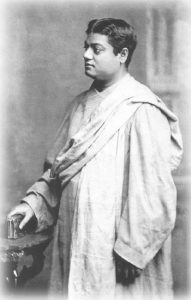
Swamiji described by Christine Greenstidel (1866-1930). She knew Swamiji well.
‘That amazing mind! What can one say that will give even a faint idea of its majesty, its glory, its splendour? It was a mind going so far beyond other minds, even of those who rank as geniuses, that it seemed different in its very nature. Its ideas were so clear, so powerful, so transcendental that it seemed incredible that they could have come from the intellect of a limited human being. He burst upon us in a blaze of reddish gold, which seemed to have caught and concentrated the sun’s rays. He was barely 30, this preacher from far away India’.
John B. Lyon to his wife when the first guests have arrived for accommodation to attend the Parliament of Religions in Chicago, Sept 1893.
‘I don’t care if all the other guests leave, this Indian is the most brilliant and interesting man who has ever been in our home and he shall stay as long as he wishes’.
Ancient India was free-thinking millennia before Europe.
In his book, ‘The Soul of India’ (Jawaharlal Nehru kept a copy on his desk), the historian Amaury de Riencourt writes, “In India, the flood of spiritual thought and new ideas is continuous and through this, they see the limitation of scientific reason and logic”. What Swamiji calls, ‘Kindergarten maps‘, ‘Intellectual Gymnastics’. (Sterling Pub. University Virginia).
Who is a Free-thinker? One who rejects authority.
For Europe to start true free-thinking, a few European thinkers had to take on some 2000 year-old Indian ideas – that Swamiji clearly presents in his lectures recorded in these books.
Further, Amaury de Riencourt writes: ‘Hegel, Schopenhauer and Nietzsche all owe considerable debt to Ancient Indian thinkers’.
Schopenhauer read the Forest Books (Upanishads) every evening of life – he obtained a Latin translation when young. Nietzsche (a professor at 24, Basel University) did his thesis on a Sanskrit book and he later wrote (1880’s ca) –
‘Only you are able to build the bridge on which you alone must cross the river of life’ – Pure Vedanta.
Nietzsche was a high school and university class mate (for one year) of Paul Deussen (Sanskrit professor, Kiel) and there is some early correspondence between them. Swamiji visited Prof Deussen in Kiel (in 1896) for 3 days, but Prof Deussen extended this meeting continually for 3 weeks, as he followed Swamiji around (with the Seviers, his companions) while he toured Germany, Amsterdam and finally reached London. Only after a further week in London did Prof Deussen finally decide to return to his university students at Kiel. Although some weeks late as term had started, they now had a vastly improved professor – he had dug deep from Swamiji’s gold mine of Vedanta and Sanskrit.
The Forest Books/Upanishads. Vedanta – refined from the Vedas. [One school from ancient India’s vast scriptures].
They have the name Forest Books because they were developed by ascetic hermits teaching disciples, living in forests. Upanishad means, ‘to sit beside’ (teacher to disciple). They are not books. The teachings were memorised. Vast tracts. The mind is capable of enormous powers of retention (our writing culture has shrunk the mind). This continuous refining of the technique of mind control and thinking (as in Vedanta’s Forest Books, not in the earlier Vedas) took place possibly over some 600 years (300BC-300AD ca). Refining away the ceremony, chants, different fires, beliefs, dogma, need for priests as go-betweens, etc; as seen throughout the Vedas. [The first Veda is The Rig-Veda; possibly 1500BC, the earliest known Sanskrit. There were four Vedas – means knowledge]. Then later comes Vedanta and the refining process.